
B
Things to do Burghers of Calais
Rodin's bronze in front of the town hall
Sights, museums and a walk through the old town
Rodin's Burghers stand in front of the town hall and its belfry, and the Cité de la Dentelle shows lace looms at work. In Calais-Nord are Place d'Armes, the 13th-century watchtower and Notre-Dame, and the Musée des Beaux-Arts has free entry. Fort Risban guards the harbour mouth, and the dragon walks along the seafront.
Rodin's bronze in front of the town hall
The lace museum in a former lace factory
A walking machine by La Machine
Working light of 1848 by the old fishing quarter
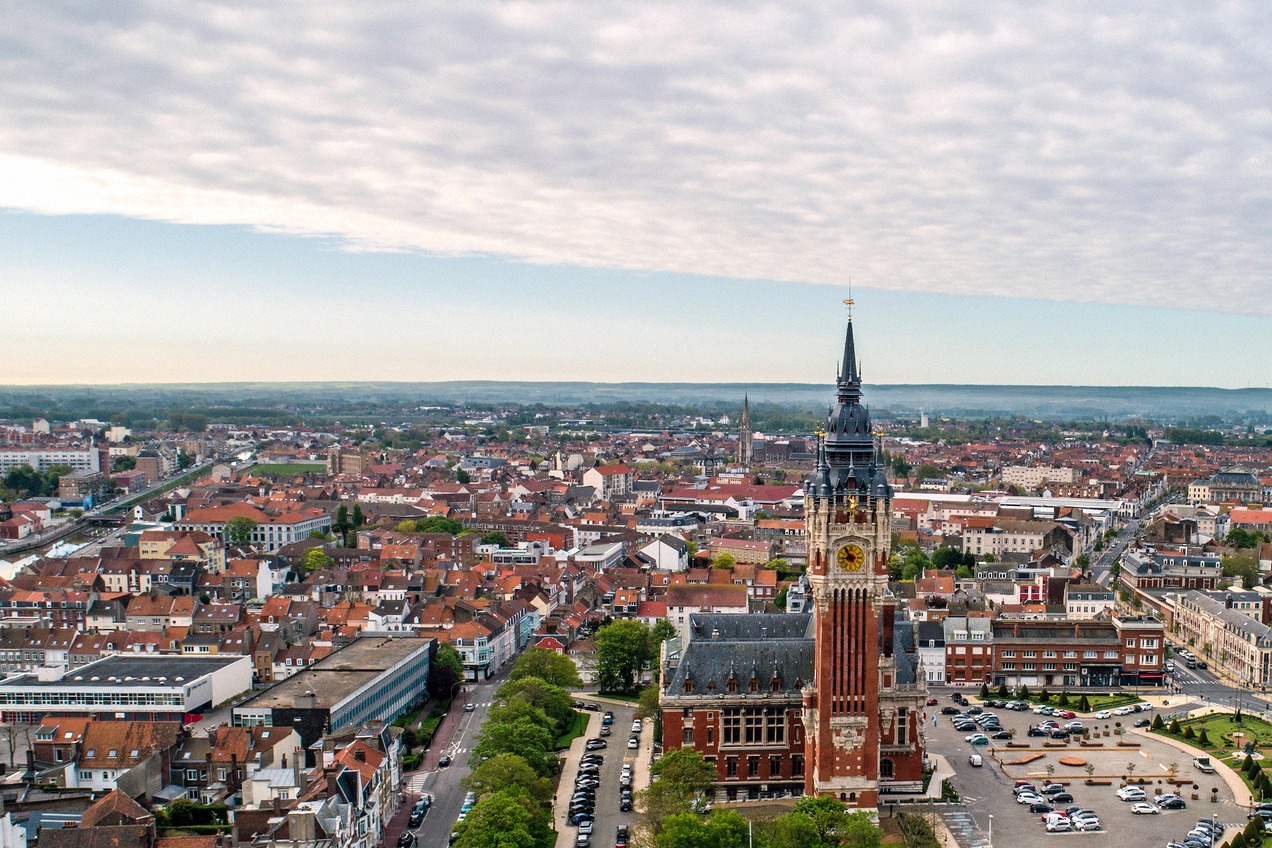
The UNESCO belfry and its walkway 55 m up
No results found.
The town hall and its belfry, a UNESCO World Heritage Site, are the place to start. A guided tour of 30 minutes climbs to a walkway 55 m up, by 175 steps or by lift, and in the main season tours run from Tuesday to Sunday without booking. In front of it stand Rodin's Burghers of Calais, the first of twelve original casts. The monument stands in the open and is freely accessible.
On Quai du Commerce, the Cité de la Dentelle occupies a former lace factory. Allow at least 90 minutes for the collection. The Leavers looms are demonstrated several times a day except on Saturdays, and the museum is closed on Tuesdays.
The dragon built by La Machine carries around 50 passengers on its back along the seafront, and a ride takes 45 to 60 minutes. For the sand and the promenade, see the beach page. Beyond the town, Cap Blanc-Nez and Cap Gris-Nez are covered under Opal Coast, Boulogne-sur-Mer under day trips and its sea centre under Nausicaá.
Under English rule, from 1347 to 1558, Place d'Armes was the Market Place. On 4 August 1347, after a siege of eleven months, the governor Jean de Vienne had the belfry bell rung here to call the townspeople together. Today a market is held here every Wednesday and Saturday, and since 2013 a bronze statue by Élisabeth Cibot has shown Charles de Gaulle and Yvonne Vendroux, based on a photograph from 1959.
On the square stands the Tour du Guet, a watchtower from the 13th century that is considered the oldest building in Calais. It was damaged by an earthquake in 1580, by fire in 1658 and by English cannonballs in 1696, and was spared in both world wars. In 1818 it was given a rotating lantern so that it could serve as a light, and at the same time it was a telegraph relay. It served as the town's light until the present lighthouse was first lit in 1848. The town flag, blue with a white cross, flies from the top.
In Calais-Nord, the church of Notre-Dame on Rue Notre-Dame was shaped by the English during their 211 years in Calais. It has been listed as a historic monument since 1913. On 23 September 1944, a week before the liberation of the town, Allied bombs hit it by mistake and its tower collapsed. Its marble and alabaster altarpiece frames an Assumption of the Virgin painted by Gérard Seghers in 1629. Charles de Gaulle and Yvonne Vendroux were married here on 7 April 1921, a day after their civil wedding. The church has had a Tudor garden since 2016 and lies on the Via Francigena.
The Musée des Beaux-Arts stands on Rue Richelieu, opposite the Parc Richelieu and five minutes' walk from Calais-Ville station. Founded in 1836, it lost more than 300 paintings when its building burned down in May 1940. The present building by Paul Pamart opened to the public in 1966. The Galerie Beaux-Arts has shown more than 250 works since 2023, and the Galerie Rodin, opened in May 2025, displays 21 sculptures on long-term loan from the Musée Rodin.
Entry is free for everyone. The museum is open from Tuesday to Friday from 09:30 to 18:00 and at weekends from 12:30 to 18:00, from November to March until 17:30, with last admission 30 minutes before closing. It is closed on 1 January, 1 May, 1 and 11 November and 24, 25 and 31 December. A ramp and a lift give access to all levels. Suitcases are not allowed, and the lockers take bags up to 55 × 35 × 20 cm.
Opposite the museum, the Parc Richelieu is where the Burghers first stood in 1895. Its war memorial by Yves de Coëtlogon was unveiled in 1962.
The lighthouse on Boulevard des Alliés was first lit on 15 October 1848 and has worked automatically, without a keeper, since 1987. The tower is 51 m tall, the light sits 58 m up, and 271 steps lead to the top. Allow 20 to 35 minutes for the climb and the view. The climb is stopped in strong wind, and the tower is not suitable for people with reduced mobility. At its foot, a discovery room explains lighthouses and sea marks.
From June to September the lighthouse is open daily from 10:00 to 12:00 and from 14:00 to 18:00. During the local school holidays it opens from 10:00 to 12:00 and from 14:00 to 17:30, and at other times of year on Wednesdays, Saturdays and Sundays. The history of the tower, its light and the visit are covered on the lighthouse page.
The lighthouse stands on the edge of the Courgain maritime, the old fishing quarter. Bombs largely destroyed it in 1940. It was not rebuilt exactly as before, but the house fronts were preserved and joined by a new building, the Immeuble de la Matelote, and its street names honour local lifeboatmen. Close by, the Monument des Sauveteurs honours the sailors lost in a rescue in 1791.
Fort Risban guards the harbour mouth on Boulevard Poincaré. The English built a tower here on a sandbank after taking Calais in 1347, and over the centuries the fort has kept its role as guardian of the harbour entrance. Its powder magazine has been restored, and the Logis du Major hosts exhibitions. From its old wall walk you can see over the harbour and the Courgain maritime.
The citadel on Esplanade Jacques Vendroux grew out of a 13th-century castle and became a bastioned fortress after 1558, with work by Vauban. In May 1940 its garrison held out for 36 hours. Since the 1960s the site has been a sports ground with the Stade du Souvenir, and its walls are the last visible ramparts of Calais-Nord. You can walk or cycle inside, and the main entrance is the Porte de Neptune next to Square Vauban.
Fort Nieulay lies west of the old town on Avenue Roger Salengro. After Louis XIV visited Calais in 1677, it was rebuilt a little further west on Vauban's advice, straddling the river so that the sluices lay inside the fort. The army used it until 1903, and in the 1980s the town took the site back and began restoring it. The fort itself cannot be visited, but its surroundings are a quiet place for walking and cycling.
The Musée Mémoire 39-45 occupies a bunker in the Parc Saint-Pierre. The Organisation Todt built it in 1941 as a telephone exchange and command post for the German navy, and it has been a museum since 1962. A visit through its 20 rooms takes about 90 minutes. In the 2026 season it opens daily from 10:00 to 18:00 from April to August, and from 11:00 to 17:00 except on Tuesdays and Sundays in February, March, September and October. It closes for the winter from 31 October 2026 to 31 January 2027.
Fort Lapin in Sangatte, built in 1690 under Louis XIV as an outpost of Fort Nieulay, later became part of the Atlantic Wall and lies on the path through the dunes from Blériot-Plage.
The military section of the Calais-Nord cemetery on Avenue Pierre de Coubertin was laid out in 1922 and holds Belgian, French and German soldiers. In the First World War, Calais was an Allied base about 60 km behind the front.
Since 2020 the Calais Street Art Festival has added more than 60 works by international artists to the town's walls, among them pieces by Jo Di Bona, Curtis Hylton, Kalouf and Anna Conda. Since 2015 a work by Banksy has been on the lifeguard post on the seafront promenade.